

Form, Function, and Footprint: A Field Test of Sustainable Concrete Solutions
As decarbonization goals take center stage across the construction sector, the cement and concrete industry faces increasing pressure to deliver measurable embodied carbon reductions without compromising performance.

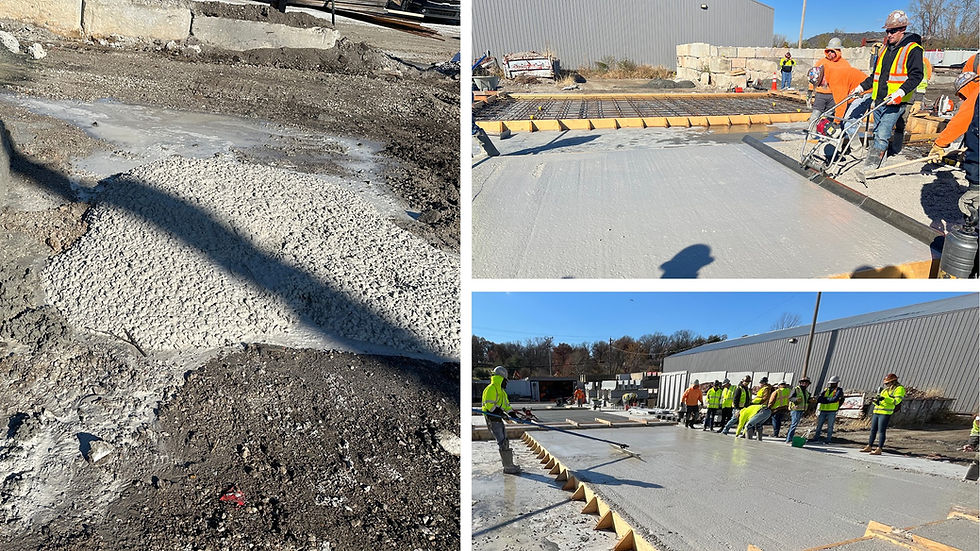

In a recent webinar hosted by the American Cement Association (ACA), Erika Winters-Downey, S.E., of Clayco Design & Engineering, and Kyle Kammer, P.E., of Concrete Strategies, shared valuable insights from field testing of sustainable concrete mixtures under real-world conditions.
The Context: Why Embodied Carbon Reduction Is Urgent
Historically, sustainable design efforts have focused on operational emissions—such as heating, cooling, and lighting —along with other energy demands that occur throughout a building’s lifecycle. But recent analyses, including those from the AIA 2030 initiative, show that operational emissions are only part of the picture. Embodied carbon—the emissions associated with manufacturing, transporting, and installing building materials—can account for more than half of a building’s total emissions over a 20-year period.
This is particularly critical in structures with high initial material intensity, such as data centers, tilt-up warehouses, and parking structures, where the structural systems and enclosures comprise the bulk of the material footprint. Structural concrete presents a significant opportunity for substantial emissions reductions.
Moreover, jurisdictions such as Colorado, New York, and California, as well as numerous local governments, are enacting Buy Clean policies that establish benchmarks and EPD requirements for state-funded construction materials.
The Experiment: Practical Research for Tilt-Up Construction
To bridge the gap between ambition and implementation, Clayco and Concrete Strategies, in partnership with Ozinga and Amazon Web Services (AWS), conducted a series of large-scale test pours to evaluate the constructability and performance of alternative cementitious systems. These trials went beyond lab analysis by pouring and lifting full-scale tilt-up wall panels—one of the most schedule-sensitive structural systems in the industry.
Phase 1: St. Louis Tilt-Up Panel Testing
Three test panels were cast in November 2023 at Concrete Strategies’ St. Louis facility:
-
Panel 1 (Control): 100% Type IL cement (Holcim St. Genevieve)
-
Panel 2: 25% slag replacement (Holcim SL), 75% Type IL
-
Panel 3: Ozinga’s proprietary ASTM C1157 blended cement, a high-substitution mixture
All mixtures targeted 5,000 psi design strength with three-day erection criteria of 50% f’c in compression and 10% f’c in flexure. Testing was conducted in ambient temperatures ranging from 19 to 34 degrees Fahrenheit, providing a real-world stress test for early strength development.
Results and Key Observations
-
Embodied Carbon Reductions vs NRMCA V3 Great Lakes Regional benchmark:
-
Panel 1 represented a 25% reduction. Even though this was the “control” mix, the specific plant producing the cement is incredibly modern in its design and operation, providing significant reductions vs industry benchmarks.
-
Panel 2’s mix represented a 42% reduction.
-
Panel 3’s proprietary mixture of ASTM C1157 blended cement represented an impressive 64% reduction.
-
-
Constructability:
-
Panel 1: Performed as expected; finishers noted no issues. Cracking was observed at the corners of openings.
-
Panel 2: The 25% slag mixture was slightly stickier to finish but otherwise equivalent in workability. The finishing crew noted less cracking than the control mixture. Importantly, it reached lifting strength even earlier than the control mixture.
-
Panel 3: Presented placement and finishing challenges during cold weather. Initially considered difficult to pump and consolidate, this mixture has since been adjusted and improved through iterative trials and has now gained acceptance among field crews. Notably, no cracking was observed in this panel before or after lifting.
-
-
Thermal Behavior: The ASTM C1157 mixture exhibited a notably low heat of hydration, making it ideal for mass concrete pours. This was demonstrated in a subsequent AWS project in Indiana, where a large amount of the proprietary mixture was successfully used for mass concrete footings—without temperature cracking.
-
Field Instrumentation: All panels were embedded with geotechnical maturity sensors and strain gauges monitored by Wiss, Janney, Elstner (WJE). Cores and field-cured cylinders confirmed strength development data.
-
Finishability: The proprietary mix had a lighter appearance and required manual finishing due to delayed set times and temperature impacts. These issues have since been mitigated by mixture modifications, including adjustments to water content and admixture selection.
Phase 2: Testing Calcined Clay
Building on the success of the first trial, a second round of field testing was conducted on the east coast with a focus on calcined clay, a natural pozzolan. Three tilt-up panels and companion slabs were poured using:
-
A 100% Type IL control mixture
-
A 20% calcined clay blend
-
A hybrid blend combining calcined clay and slag
All mixtures performed acceptably in field conditions. Strength targets were achieved within standard timelines, and finishers reported minimal differences in handling once the admixtures and water content for each mix were dialed in. Embodied carbon savings ranged from 20% to 33%.
Best Practices for Specifiers and Contractors
Conclusions provided detailed guidance for engineering and construction professionals seeking to integrate low-carbon concrete solutions into their projects:
-
Move to Performance-Based Specifications
Avoid prescriptive cement content or Type I/II requirements that may be obsolete or unavailable in many markets. Instead, specify strength, exposure class, and performance metrics. -
Include a Carbon Budget in Your Construction Documents
Develop a table of concrete mixtures used on the project, including volumes and global warming potential (GWP) values. Multiply these to generate a project-wide embodied carbon estimate and set a reduction target. -
Allow for Mix Iteration and Field Testing
Plan for extra time and cost to test novel mixes. Use mockups or non-structural pours (e.g., lunch tents or equipment pads) to trial finishability and performance. -
Engage Local Partners
SCM availability varies significantly by region. Engage with local ready-mix suppliers and other stakeholders early in design to align goals and feasibility. -
Build In Flexibility
Plan for weather, delivery delays, or batch variability. Understand that lower-carbon mixes may behave differently in hot or cold weather. -
Ensure Experienced Review of Submittals
Reviewers need to be knowledgeable about EPDs, SCM compatibility, and regional sourcing. Product-specific, current EPDs should be required wherever possible.
Conclusion: A Practical Path Forward
These field-tested case studies demonstrate that low-carbon concrete is not only technically feasible, but also constructable, finishable, and scalable. Success depends on early planning, open collaboration, and a willingness to iterate. For large-scale clients like AWS, the desire to fund pilot studies and evolve materials in partnership with suppliers has led to significant embodied carbon savings.
As the industry moves toward performance-based specifications and increasing transparency, lessons from these field trials offer a blueprint for successful implementation. Sustainable construction doesn’t have to be theoretical; it can be formed, finished, and lifted into place.
The cement industry is evolving, and blended cements account for 65% of consumption in the U.S. -- a share that is projected to continue climbing in the years ahead.